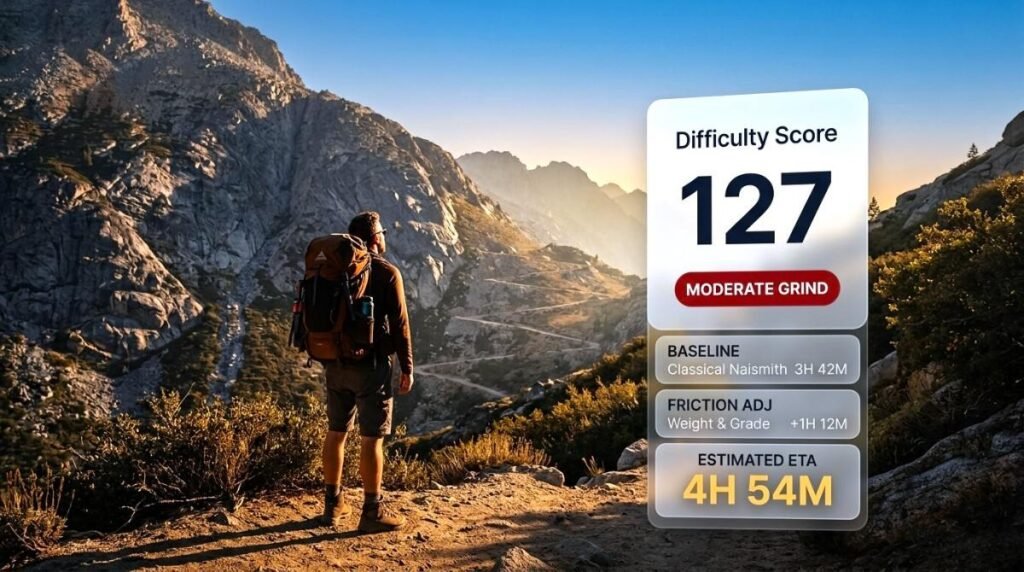
TL;DR: Naismith’s 1892 rule estimates hiking time from distance and elevation alone but that’s a useful start, not a finished answer. But it only gets you a rough baseline: 3 mph flat, plus one hour per 2,000 ft of climbing. Real trail time depends on pack weight, terrain, and elevation loss too. The calculator I’ve built blends these all factors into one solution, and the tables below show exactly how much each one changes your time.
A hiking time calculator built only on Naismith’s Rule gets your baseline right and almost everything else wrong. But the thing we’re presenting to you is built different.
⛺ Hiking Time Calculator
Get a conservative, personalized time estimate built from distance, elevation, and the real-world factors that actually slow you down on trail.
Trail Basics
Total planned distance, round-trip for out-and-back routes.
Total cumulative ascent for the whole route.
Total cumulative descent. Leave at 0 if return matches ascent.
Solo hikers see no group penalty; larger groups move slower.
Most hikers underestimate rest time. 30 minutes is a realistic minimum for a half-day hike.
Leave at 0 to use the standard default pace.
Supporting Metrics
What’s Driving Your Time
Interpretive Guidance
—
| Trail Type | Effect on Pace |
|---|---|
| Smooth Trail | No penalty |
| Rocky / Uneven | −20% pace |
| Muddy / Slippery | −30% pace |
| Snowy | −50% pace |
| Pack Weight | Slowdown |
|---|---|
| Under 15 lb (7 kg) | No penalty |
| 45 lb (20 kg) | ~18% slower |
| 75 lb+ (34 kg+) | Up to 35% slower |
The 1892 formula assumes flat, dry ground and a light daypack. Add a loaded backpack, loose scree, or a long descent, and the gap between predicted and actual time can stretch past an hour. This predictor starts with Naismith’s baseline, then layers in pack weight, trail surface, and your real walking pace. Enter a route once and get a number built for the ground you’re actually covering, not a Scottish hillside from 130 years ago.
The Baseline Calculation: What Most Trail Apps Get Wrong
Most mapping apps assume flat, paved ground at a constant speed, because that’s the terrain model they were built for. That assumption has caused real harm. Google Maps once estimated 5 hours 13 minutes for the Howe Sound Crest Trail. The actual time is 12 to 14 hours, due to 1,300m of elevation gain and loose-rock obstacles the app never factored in. Hikers who trusted that number needed Search and Rescue.
It’s not an isolated case. A peer-reviewed comparison of Komoot, Outdooractive, and posted trail signage found average errors of 30 to 70 minutes per hike, with variance close to an hour even on the better-performing tools. The failure is structural: these apps apply one flat-rate speed and bolt elevation on as an afterthought, instead of building terrain and load into the estimate from the start.
That is exactly why the tool we built forces you to input real-world friction layers like your pack load, your footing, and your physical velocity profile, temperature, terrain type, elevation gain/loss etc. in order to transform a rigid textbook estimate into a realistic, survival-ready ETA.
Pacing Dynamics: Classic Heuristics vs. Real-World Friction
Visualizing non-linear time degradation when compounding grade, pack weight, and terrain variables.
How Long Does It Take to Hike a Mile? Fast Hiking Time Calculator Answers
On flat, smooth trail at an average pace, one mile takes about 20 to 24 minutes. Here’s how that scales:
| Distance | Estimated Time (flat, no pack) |
|---|---|
| 1 mile | ~22 minutes |
| 3 miles | ~1 hour 6 minutes |
| 5 miles | ~1 hour 50 minutes |
| 10 miles | ~3 hours 40 minutes |
Why a Trail Pace Predictor Needs More Than Distance
Two routes of identical length can differ by hours depending on what’s underfoot and what’s on your back.
Elevation and Surface
Grade changes metabolic demand at a nonlinear rate. Past roughly 15% incline, your gait shifts from walking to a stepping-and-pulling pattern that burns disproportionately more energy per horizontal foot. A flat-rate estimate can undershoot time on steep approach trails by 30% or more.
Pack Weight
Every added pound shifts your center of mass and increases joint torque with each stride. Past about 20% of bodyweight, climbing speed drops sharply. Descents carry a separate cost: your quads work eccentrically to brake a heavier load, and that strain is usually what slows hikers on the way back down.
Pace Range
A trained trail runner and a casual weekend hiker can cover the same route at a 2 to 3x difference in sustainable speed. A single “average” pace baked into a formula is close to useless at either end of that range, which is why this tool lets you set a custom pace instead of forcing one on you.
What Slows You Down, By the Numbers
| Trail Surface | Effect on Pace |
|---|---|
| Smooth Trail | No penalty |
| Rocky / Uneven | −20% pace |
| Muddy / Slippery | −30% pace |
| Snowy | −50% pace |
| Pack Weight | Slowdown |
|---|---|
| Under 15 lb (7 kg) | No penalty |
| 45 lb (20 kg) | ~18% slower |
| 75 lb+ (34 kg+) | Up to 35% slower |
These are the exact multipliers the calculator runs on. A rocky trail with a 45 lb pack doesn’t just add two small penalties, it compounds them, which is why the tool above will always beat manual math.
Real-World Benchmarks
| Trip Type | Inputs | Result |
|---|---|---|
| Single-day peak push | 11 km, 1,000m gain, smooth trail, light pack | ~4h 42m |
| Weekend backpacking leg | 25.5 mi, 3,000 ft gain, rocky trail, 35 lb pack | ~15.5h total, split across two days |
| Technical trail run | 32 mi, 6,500 ft gain, rocky singletrack, custom pace | Strategy shifts from speed to descent control |
Note: “These are illustrative examples built on fixed inputs. Enter your own trip details into the calculator above for a live result.”
Where This Calculator Reaches Its Limits
No trail time estimate, including this one, fully models altitude, extreme descent, or unstable ground. Above roughly 10,000 ft, unacclimatized hikers see measurable oxygen saturation drops, which cuts aerobic output at the same heart rate and effort level. Steep descents beyond about 20% grade often move slower than the equivalent climb, since braking force replaces propulsive force in your legs. Snow and mud cut stride length and push-off force in ways no distance formula can fully capture in advance.
Factors That Intentionally Degrade Prediction Accuracy
No trail ETA calculator — this one included — fully models three conditions: altitude physiology, extreme descent gradients, and unstable ground. Treat outputs in these categories as directional guidance, not exact numbers.
Extreme High-Altitude Hypoxia
- Above roughly 10,000 ft, blood oxygen saturation (SpO2) begins measurable decline in unacclimatized hikers
- Aerobic output drops even at identical heart rate, meaning the same effort produces less forward speed
- Neither distance nor gain accounts for this — it’s a physiological ceiling the tool can’t observe directly
Extreme Downhill Gradients
- Steep descents switch working muscles into eccentric contraction, effectively “braking” body weight with every step
- This slows travel speed despite elevation dropping, the opposite of what a linear pace model would predict
- Grades beyond roughly 20% down often move slower than the equivalent uphill segment
Severe Environmental Disruption
- Snowfields and scree fields cut effective stride length and push-off force
- Active mud adds direct resistance and increases fall risk, both of which force deliberate pace reduction
- Whiteout or low-visibility navigation adds route-finding time no distance formula can capture
How to Get the Most Accurate Estimate
- Split multi-day routes into single-day segments instead of running the whole loop through one calculation.
- Enter a custom pace once you know your number from a prior hike on similar terrain.
- Round elevation gain up. Trail apps frequently undercount small rollers.
- Re-run the calculation separately for each terrain change on a route instead of averaging across the whole distance.
- Budget real rest time. Photo stops, snack breaks, and navigation checks add up fast. Plan at least 30 minutes for a half-day hike, more if summit stops are involved.
FAQ
How accurate is Naismith’s Rule?
It’s accurate mainly for fit hikers on dry, even terrain with light gear. Outside those conditions, it consistently underestimates time on steep or technical routes, which is why this tool layers terrain and load corrections on top instead of replacing it.
Does pack weight really slow hiking speed?
Yes, and the effect isn’t linear. A pack under 15 lb adds almost no penalty. At 75 lb or more, you can be moving up to 35% slower than the same route with a light daypack.
How long does it take to hike 5 miles?
On flat, smooth trail at an average pace, about 1 hour 50 minutes. Add elevation gain, pack weight, or rough terrain and that number climbs. Use the calculator above for a route-specific result.
Should I use miles or kilometers?
Either works. The calculator converts internally, so use whichever unit matches your map source or GPS device.
Why is my calculated result different from my GPS watch?
Your watch logs what actually happened, including rest stops and real-time terrain reactions the calculator can’t see in advance. Treat this tool’s output as a planning estimate and your watch data as the benchmark to refine future custom pace inputs.

Ethan Marlowe is an experienced hiker and outdoor gear specialist based in Colorado. With over 7 years of hands-on experience trekking through the Rockies, Pacific Northwest, and East Coast trails, he delivers practical advice, expert gear reviews, and survival insights. His goal is to help hikers of all levels make smarter decisions on and off the trail.